The function

Operating Model Office

The organizational home for disciplined change, governed execution, and sustainable operating capability — aligned under one function instead of scattered across departments.

"The OMO is how organizations scale, change, and grow without losing the discipline that made growth possible."

Most organizations manage change through fragmented efforts: project management here, process improvement there, communications somewhere else. The OMO integrates these capabilities into a single, evidence-based function aligned to leadership priorities. The result is operating clarity — defined work, governed execution, measurable adoption, and sustainable outcomes.

01

Process Analysis & Architecture

Structured documentation and design of operating processes with defined owners, decision points, and performance measures.

02

Governance & Execution Support

Decision frameworks, escalation paths, and cadence that keep strategic priorities in motion without constant leadership intervention.

03

Adoption & Behavior Change

Structured change support that moves capability from design to daily practice with measurable adoption indicators built in.

04

Data-Driven Decision Support

Evidence-based operating data that replaces tenure-based assumptions and helps leaders make faster, better-informed decisions.

The system

Operating Model Management System

The daily management layer that connects frontline execution to corporate strategy — and feeds structured improvement signals into the FORGE Framework™.

The Corporate Operating Model sets direction. FORGE drives structured improvement. The OMMS is the connective tissue between them: where local execution happens, plan-versus-actual is reviewed, and recurring issues surface as improvement signals.

Without a functioning OMMS, strategy documents don't reach the frontline and improvement projects don't connect back to operations.

Local execution: Frontline teams operate within a defined structure, with clear standards and daily accountability mechanisms.

Daily management: Visual management, huddle cadence, and plan-vs-actual reviews that keep execution visible and governed.

Signal generation: Recurring issues and improvement opportunities escalate into FORGE rather than being absorbed or ignored.

Reintegration: Improved standards and redesigned processes flow back into operations, closing the improvement cycle sustainably.
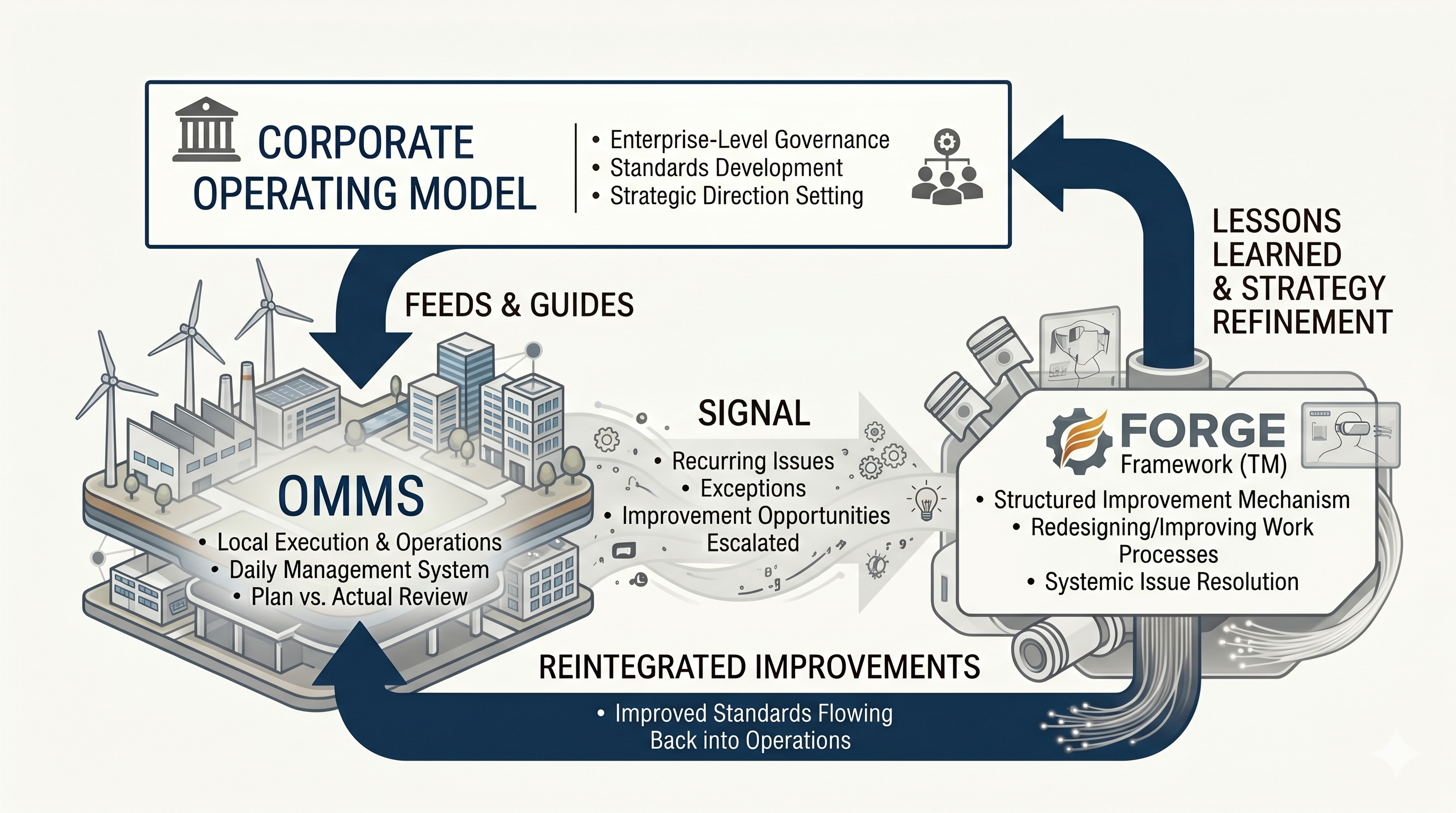
OMMS diagram — Corporate Operating Model feeding OMMS, signals flowing to FORGE Framework, improvements returning to operations

The methodology

FORGE connects analysis, prioritization, problem definition, solution design, and sustainment into a repeatable, governed sequence — replacing ad hoc improvement with disciplined execution that sticks. The methodology is identical across all three engagement tiers. What scales is the depth of evidence, governance structure, and who carries the analytical work.

01
Filter
02
Objective
03
Root
04
Generate
05
Endure

Capabilities

What we deliver

Each capability is designed to integrate with the others — not sold as isolated interventions that leave gaps in your operating model.

01

Operating Model Design

End-to-end design of how your organization structures, governs, and executes its work — aligned to strategic priorities and built for the scale you're heading toward.

02

OMMS Implementation

Design and deployment of your Operating Model Management System — the daily management infrastructure that connects frontline execution to corporate strategy and feeds improvement signals into FORGE.

03

Process Architecture

Structured documentation and redesign of core business processes, with defined owners, decision points, performance measures, and integration across functions.

04

Governance Frameworks

Decision rights, escalation structures, and operating cadence that keep strategic priorities in motion without requiring constant leadership involvement in operational detail.

05

Continuous Improvement Enablement

Lean Six Sigma-grounded capability building — establishing the operating discipline, measurement infrastructure, and problem-solving culture required for sustainable improvement.

06

Change & Adoption Support

Behavioral integration that moves capability from design into daily practice, with measurable adoption indicators and sustainment structures built into the delivery model.

07

Transformation Office Design

Build or restructure the internal function responsible for governing change — defining scope, resourcing, governance, and integration with existing project and process functions.

08

Decision Support & Data-Driven Execution

Operating dashboards, performance indicators, and reporting structures that give leadership reliable signal — replacing assumption-based decisions with evidence-based operating discipline.

"The framework isn't the point. Sustainable operating capability is the point. FORGE is how we get there."

Start a conversation