
What FORGE Is
FORGE stands for Filter, Objective, Root, Generate, and Endure. It is a delivery architecture that integrates five disciplines: Lean Six Sigma, process architecture, ISO quality and security standards, structured change management, and structured project management, into one concurrent operating system rather than running them as separate workstreams.
The difference is not the individual components. Most serious practitioners already use versions of these tools. The difference is that in FORGE they run at the same time. While the process is being redesigned, the risk and control framework is going in around it. While the solution is being built, the adoption plan is already running. When the solution goes live, the governance rhythms that prevent backsliding are already in place, not planned afterward.
That sequencing is what makes the difference between a project outcome and a permanent capability.
The Capability Gate
The most important control point in the framework is something I call the Capability Gate.
The rule is simple: no software is selected and no process is reconfigured until the process is proven to be working as consistently as it can work given its current design.
Technology amplifies what exists.
If what exists is broken, technology makes the breakage faster and more expensive. The Capability Gate is a signed, evidenced control artifact, not a conversation, not a meeting, not a slide. It prevents premature investment in automation and tooling before the underlying process is stable enough to benefit from it.
This runs counter to how most organizations operate. When the schedule is tight and the technology team is ready to build, the temptation is to move. The Capability Gate prevents that. I have seen this failure mode enough times that it is now non-negotiable in every engagement I lead.
The Operating Architecture
The diagram below shows how all five FORGE phases connect into a closed-loop operating system, from strategic intake and prioritization through capability and maturity build, with evidence gates, guardrails, and value streams running throughout.
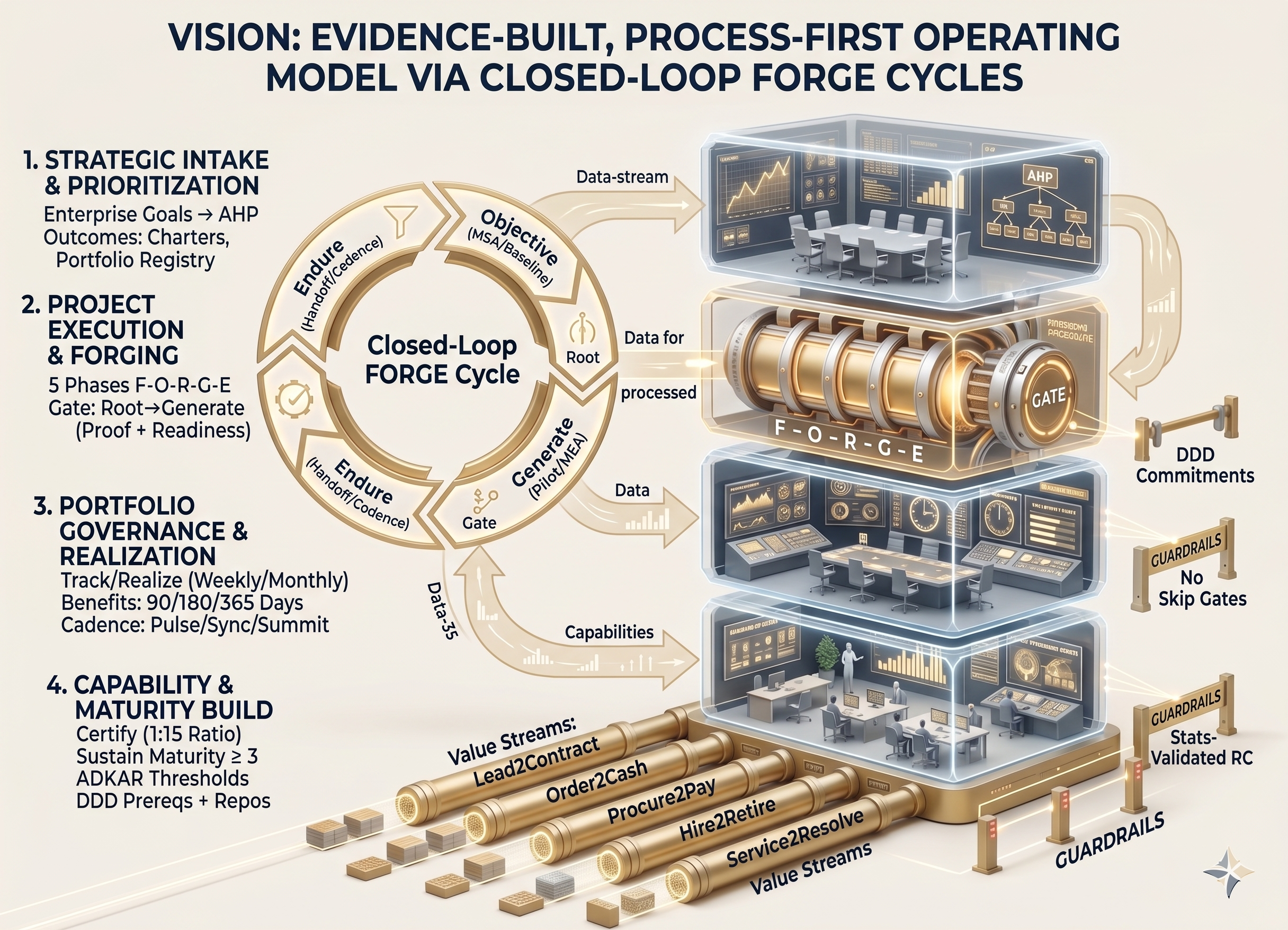
Four operating disciplines run concurrently across the cycle:
- Strategic Intake & Prioritization: Enterprise goals feed an analytical hierarchy process, producing charters and a portfolio registry before a single improvement hour is spent.
- Project Execution & Forging: All five F-O-R-G-E phases run with a formal Gate between Root and Generate requiring proof of root cause and organizational readiness before build begins.
- Portfolio Governance & Realization: Benefits are tracked at 90, 180, and 365 days post-implementation. The Pulse/Sync/Summit cadence keeps governance active, not ceremonial.
- Capability & Maturity Build: The organization develops its own internal FORGE practitioners at a 1:15 certification ratio, sustaining maturity at level 3 or above with evidence-based readiness thresholds and data-driven readiness prerequisites.
No skip gates. Stats-validated root cause only.
The guardrails visible in the blueprint are not suggestions. They define the non-negotiable control points that prevent the most common failure modes: moving to technology before the process is stable, and moving to implementation before root cause is evidence-confirmed.
The Honest Constraints
FORGE is not for every situation, and I am not going to pretend otherwise.
FORGE requires organizational patience. The Filter and Objective phases take time because they are evidence-driven, not assumption-driven, feeling-driven, or tenure-driven. If your organization needs a solution deployed in 30 days regardless of whether the root cause is understood, this is not the right approach. Fast and wrong is still wrong.
FORGE requires executive sponsorship that holds. The Capability Gate and evidence-based scope decisions will create friction with teams that want to move faster than the data supports. Without a sponsor willing to hold the line, the framework gets diluted into the same sequential, assumption-driven process most organizations already run.
FORGE is designed for complex, multi-variable problems in regulated or operationally significant environments. For simple, low-risk process tweaks, the framework is more structure than the problem needs. A good practitioner knows the difference.
The Detractor Arguments, and Where I Land
I have heard the pushback. Here is my honest response to each one.
"This is just process improvement with extra steps."
Lean Six Sigma problem-solving is a component of FORGE, embedded in the Root and Generate phases. FORGE is a delivery architecture. It tells you how to identify which process to work on, how to build the governance that sustains the improvement, how to integrate compliance into the design rather than auditing for it afterward, and how to ensure the people doing the work are ready before the solution goes live. Calling FORGE a problem-solving methodology is like calling a building a foundation.
"Adding ISO standards makes this too compliance-heavy for most organizations."
ISO 9001, ISO 27001, and ISO 31000 principles are not compliance overhead in this framework; they are design constraints. Embedding quality controls, security requirements, and risk thresholds into the process design from the start is easier and less expensive than retrofitting them after the fact. Most organizations that struggle with ISO audits do not have a compliance problem. They have a process design problem. FORGE addresses both at the same time.
"Change management is soft skills, not rigorous methodology."
The Transformation Equation answers this directly:
Quality of Solution × Human Adoption = Organizational Effectiveness
A technically perfect solution with zero adoption produces zero results. Change management is not a soft skill in this framework; it is a mathematical multiplier. Ignoring it does not make an engagement more rigorous. It makes the ROI calculation incomplete.
"Proprietary frameworks are just consultant marketing."
That is a fair challenge and I take it seriously. The FORGE Framework is built on proven, publicly documented methodologies: Six Sigma, Lean, ISO standards, structured change management, and project management. The framework does not invent new tools. It integrates existing ones into a concurrent operating system and adds two elements not formalized elsewhere: the Capability Gate as a signed, evidenced control artifact, and the Process Relevancy Review that connects the final phase back to the first phase to create a self-renewing improvement cycle. If those two elements produce better outcomes than running the same tools in sequence, the framework has earned its name.
Why I Built It
My personal mission is to unlock the potential in people and processes, then hand over the keys.
I am not interested in building dependency. Every engagement should end with the organization holding the process maps, the governance dashboards, the SOPs, and the sustainment rhythms, and running them themselves. That is the measure of success.
The FORGE Framework is the architecture I use to get there consistently. Forged for Excellence. Designed to endure.
Ready to put FORGE to work?
A 30-minute strategy conversation is enough to assess whether your current improvement efforts are structured for sustainable results or quietly set up to fade.
Schedule a Strategy Conversation