
Not because the problem is wrong, and not because the team lacks capability. Because no one made a deliberate decision about the right scale of response before the work began. An enterprise team gets assembled to solve a problem that a single site could have handled in two weeks. Or a local team quietly works a structural issue that needed cross-functional alignment and executive authority to actually resolve. Either way, the mismatch between the problem and the response is set before the first meeting takes place.
Filter is the phase that prevents that mismatch.
What Filter Actually Does
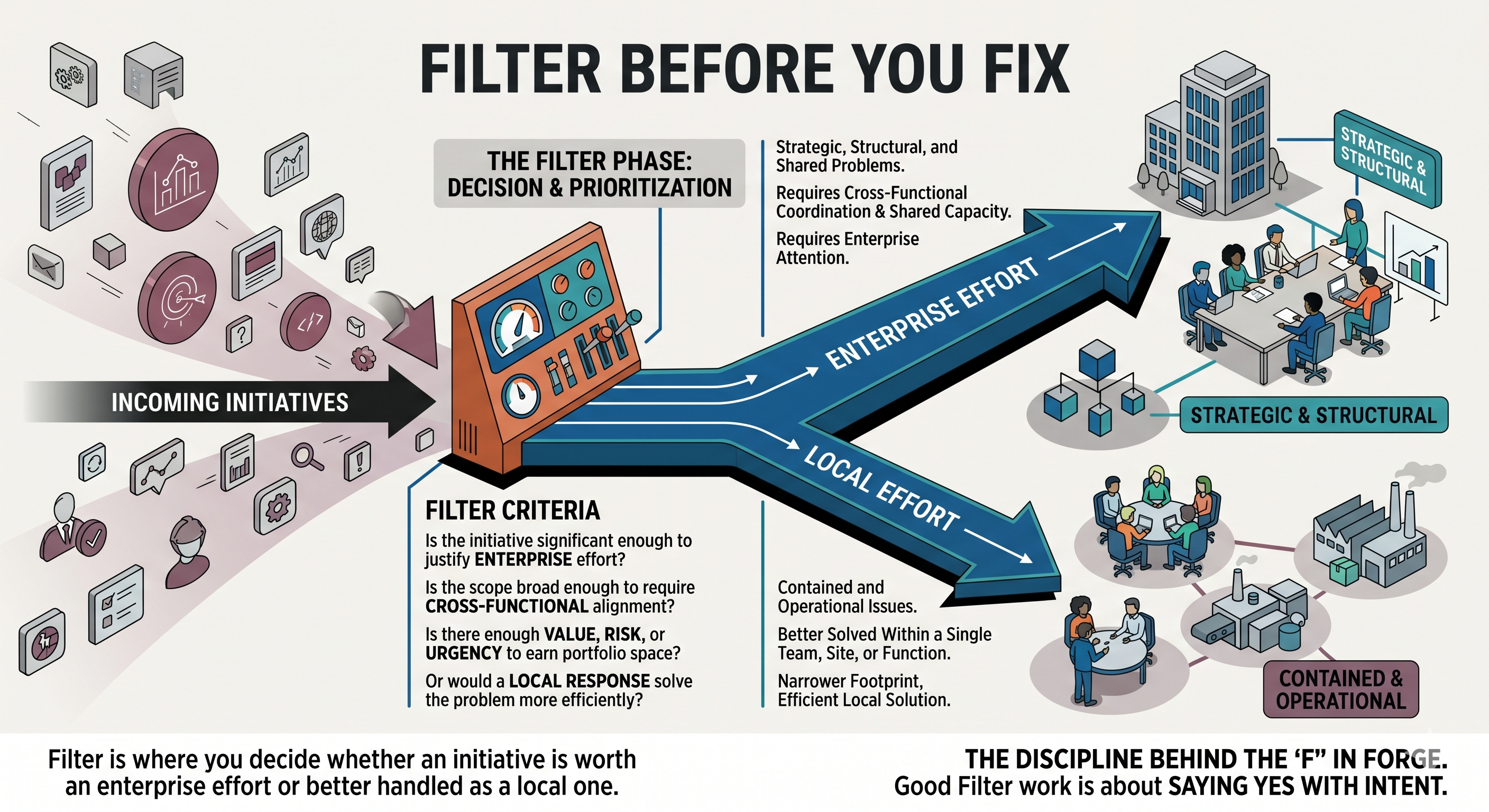
The Filter phase is where a deliberate decision gets made about the initiative itself before any solving, improving, or redesigning begins. It is not a gate that slows things down. It is a decision point that ensures the right level of the organization is engaged, with the right resources, for the right reasons.
That decision matters more than most organizations recognize. Scale a response too large and you consume enterprise capacity, cross-functional attention, and portfolio space on a problem that did not need them. Scale it too small and a structural issue gets worked locally by people who lack the authority, the data, or the organizational reach to actually fix it. The problem gets addressed. The root cause does not.
Good Filter work is not about saying yes faster. It is about saying yes with intent.
The Questions Filter Asks
Before any initiative moves forward, Filter requires honest answers to four questions:
Is the initiative significant enough to justify enterprise effort?
Not every problem that surfaces at the executive level requires an enterprise response. Significance is a function of strategic impact, financial exposure, and organizational risk, not organizational visibility. Getting this wrong in either direction wastes capacity or leaves a structural problem unaddressed.
Is the scope broad enough to require cross-functional alignment?
If the solution requires decisions, resources, or behavior changes from more than one function, local ownership is not enough. Cross-functional problems handled locally produce locally optimized solutions that create friction everywhere else. The question is not who raised the issue. It is who is affected by it.
Is there enough value, risk, or urgency to earn portfolio space?
Portfolio space is finite. Every initiative that enters the enterprise queue consumes capacity that cannot go to something else. Filter forces that tradeoff to be made explicitly, with an order of magnitude estimate of value or risk, rather than by default or by whoever made the most noise.
Or would a local response solve the problem more efficiently?
This is the question most intake processes never ask. A contained operational issue handled at the site level by the people closest to it is faster, cheaper, and more durable than the same issue escalated into an enterprise program. The default assumption that every surfaced problem warrants a formal response is expensive and usually wrong.
What Happens When Filter Gets Skipped
The consequences of skipping Filter are predictable and expensive, in either direction.
When a local problem gets escalated to enterprise scale, the organization pays in capacity and credibility. A cross-functional team spends weeks on a problem that the front line could have resolved in days. Resources get committed, a steering committee gets stood up, and when the initiative closes, the output is roughly what a site manager would have produced with two conversations and a root cause analysis. The overhead was real. The value was not proportionate.
When a structural problem gets handled locally, the organization pays in false resolution and blind spots. The local team closes the issue within their line of sight. But because Filter was never run, the right people were never in the room. Impacted functions, downstream processes, and adjacent teams were never consulted. The solution gets designed around the visibility of whoever raised the issue, not the full footprint of the problem. The silo effect does not just limit the solution. It limits the definition of the problem itself. The underlying condition keeps producing the same issue in slightly different forms, and each recurrence gets handled locally again by people who still do not know what they do not know.
Filter does not eliminate either risk entirely. It makes the decision about which risk to take a conscious one rather than an accidental one.
Filter in the Context of FORGE
Filter is the first phase of FORGE for a reason. Nothing downstream works correctly if the initiative was sized incorrectly at intake. An objective set for an enterprise initiative is the wrong objective for a local one. A root cause analysis scoped to one function misses structural causes that live across functions. A solution designed without the right stakeholders fails to account for the constraints those stakeholders would have surfaced.
The sequence is causal, not administrative. Get Filter right, and the rest of the framework operates on a solid foundation. Skip it, and every subsequent phase is building on an assumption about scale and scope that was never validated.
Filter is where you decide whether an initiative is worth an enterprise effort or better handled as a local one.
That decision, made deliberately and with the right evidence, is where the real leverage lives.
Are your initiatives sized to the right problem?
A 30-minute strategy conversation is enough to assess whether your current intake process is making that decision deliberately or by default.
Schedule a Strategy ConversationPart of an ongoing series on operational design, process transformation, and what it takes to make change endure.